
Or how I discovered that home can have two postcodes
So there I was, stepping off the plane at Heathrow with my oversized luggage (okay, fine, three suitcases of which one was entirely dedicated to my mother’s lovingly packed masalas), ready to begin my British adventure. Little did I know I was about to fall head over heels in love with a country that would teach me that life can be beautifully different and wonderfully similar at the same time.
Ah! Scotland . The land of bagpipes, lochs and kilts. As an Indian landing in Scotland you are in for a treat! But let’s be real, it’s not all haggis and Shortbread. The cultural differences can be overwhelming. Fear not dear Indian friends, for I’ve got you covered.
Scotland’s got a unique charm that’s sure to win you over. From the rugged Highlands to the vibrant cities, there’s so much to explore. But, be warned, the Scots have a language all their own. You’ll need to decipher the mysteries of scottish slang from “banger”( a sausage) to ” dram” (a wee drink) .
I always thought moving to the UK meant trading chaos for civility, and dust for daffodils. Turns out, I just traded the scorching, reliable heat of the Indian sun for a sky that looks perpetually like a forgotten, damp dishcloth. My husband, who still believes he can manifest sunshine by performing a small surya namaskar indoors, calls it ‘character-building.’ I call it a conspiracy by the British Weather to keep the Vitamin D supplement industry booming.
The Weather: A Gateway to Friendship
Back in Pune in India, my clothes dried on the line with the efficient brutality of a thousand-watt bulb. Here, the holy grail of domesticity is a Tumble Dryer. It’s a machine that takes 90 minutes and enough electricity to power a small village just to give you a shirt that smells vaguely of lukewarm disappointment. I now spend my afternoons staring wistfully at the rain, dreaming of my mother’s maid who could iron ten clothes while simultaneously judging my life choices. That was efficiency.
Back home in India, talking about the weather is what you do when you’ve run out of things to say, which is never, because we’re Indian and silence makes us deeply uncomfortable. But here in the UK, the weather isn’t small talk—it’s THE talk.
Back in India, we have monsoons that announce themselves like a Bollywood entry scene—dramatic, loud, impossible to ignore. Here in the UK, rain is gentle, persistent, and comes with its own social superpower: instant conversation starter.
“Lovely day, isn’t it?” becomes the magic phrase that transforms strangers into friends. Within weeks, I discovered that British weather-talk isn’t small talk—it’s a warm invitation to connect. It’s genius, really. While we Indians bond over cricket scores and Bollywood gossip, the Brits have created a universal language that works with literally everyone. Rain or shine (mostly rain), you’re never without an opening line. Within a week, you find yourself doing it too. You’re standing at the bus stop, turning to a complete stranger and saying, “Bit chilly today!” You’ve become one of them.
The Queue: An Art Form
And speaking of queuing—it’s the national sport. If three Indians in UK accidentally stand in a line waiting for a bus, we instinctively start discussing if we can jump the queue via a complicated system of nods and phone calls. In London, people queue for everything. A queue for the queue. A queue to complain about the previous queue.
Let me tell you what’s absolutely magnificent about British queuing culture: it’s the most egalitarian thing I’ve ever witnessed. Doesn’t matter if you’re a CEO or a student, wearing Prada or Primark—everyone waits their turn.
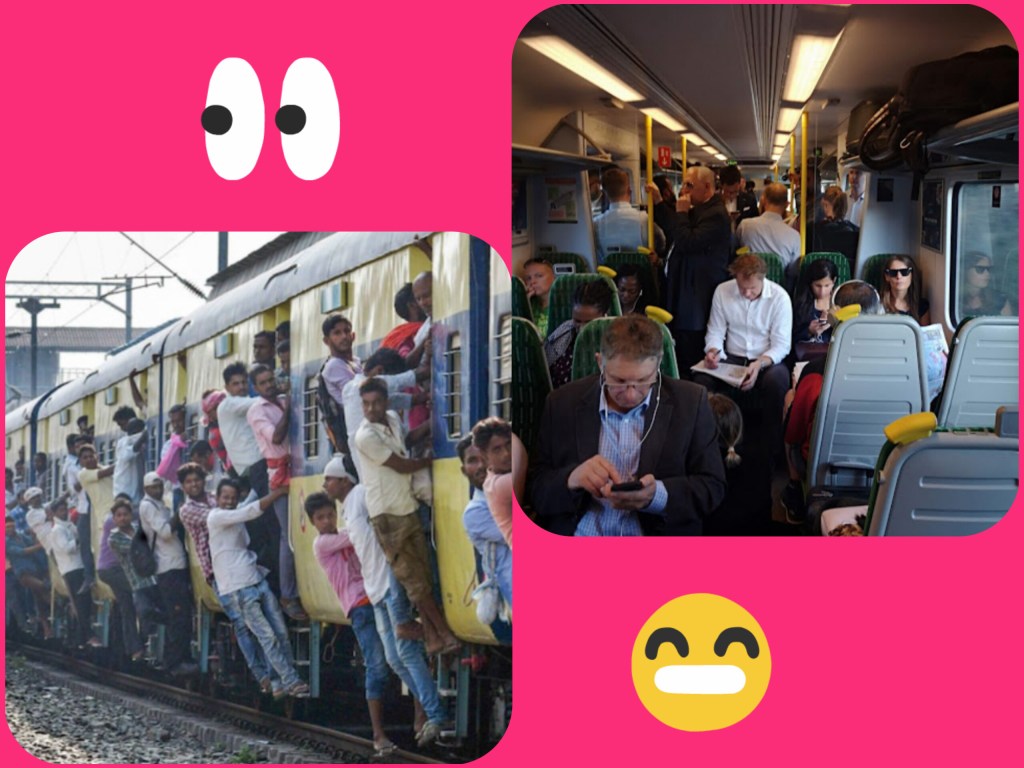
In India, we have our own beautiful chaos—a system where assertiveness and community-building happen simultaneously in crowded spaces. It works for us! But there’s something deeply calming about knowing that in the UK, fairness is baked into everyday life. One person, one place in line, infinite respect for the system.
Both approaches teach us something valuable: Indians teach the world about adaptability and building connections even in chaos; the British teach us that patience and order can be their own reward. Why choose when you can appreciate both?
The Art of “Sorry”: Kindness in Three Syllables
And the mandatory 47 times you have to say “sorry” in a single day, even when someone else walks into you. My ‘sorry’ reflex is now so primed, I apologised to a toaster the other morning for having forgotten to buy bread. This is the NRI life.
(Jokes apart). I want to say something serious.
Indians are wonderfully hospitable—we’ll feed you until you can’t move and insist you stay longer even when you’re clearly exhausted. The British have their own superpower: politeness so embedded in their DNA that it’s practically an art form.
That “sorry” you hear everywhere? It’s not weakness; it’s social lubrication that keeps a diverse, bustling society running smoothly. Someone bumps into you, and you both apologize—it’s not confusion, it’s a beautiful acknowledgment that we’re all human, we all make mistakes, and kindness costs nothing.
I’ve learned that British politeness and Indian hospitality are two sides of the same coin—both cultures deeply value respect and consideration for others. We just express it differently, and honestly? The world needs both approaches.
But look, you adapt. You learn to wear three layers indoors. You learn that heating a house to an Indian-summer temperature is a financial decision roughly equivalent to buying a small yacht. And you realise that in the profound, quiet dampness of the UK Cultural Shock, there is a strange comfort. It’s like being wrapped in a very expensive, slightly mouldy security blanket. I guess that’s what they call Moving to UK. Now, if you’ll excuse me, my sweater is still wet. I’m off to have a polite, bland cup of tea and stare at the grey sky some more.
The Great Central Heating Mystery
In India, we have two temperatures: “Why is hell in my room?” and “It’s pleasant today.” In the UK, they have central heating, which sounds luxurious until you realize it’s controlled by a thermostat that only responds to blood sacrifice and ancient incantations.
Your flat is either the Sahara Desert or Antarctica—no middle ground. You’re walking around in shorts while your radiator pumps out enough heat to power a small steel mill, or you’re wearing three jumpers because turning the heating on requires a degree in mechanical engineering and a small mortgage to afford the gas bill.
Dinner at 6 PM?
Back in India, 6 PM is when you’re having your evening chai and contemplating what you’ll eat for dinner at 9:30 PM. Here, 6 PM IS dinner. By 7 PM, kitchens are closed. By 8 PM, the streets are emptier than my bank account.
The first time someone invited me for dinner at 6, I showed up fashionably late at 7:30 (which in Indian time is actually early). They’d finished eating and were loading the dishwasher. I stood there clutching my bottle of wine, looking like I’d missed the last train to civilization.
The Tube: Where Eye Contact Goes to Die.
Speaking of the tube—nowhere else in the world will you find people so determinedly ignoring each other’s existence. You’re squeezed against someone’s armpit, your face is essentially in a stranger’s newspaper, and everyone is pretending they’re alone in a vast, empty field.
In India, we’d have started a conversation, exchanged life stories, connected on WhatsApp, and invited them to our cousin’s wedding by now. Here, making eye contact is considered a declaration of war.
The Accent Confusion
“Sorry, could you repeat that?” becomes your most-used phrase. Not because you don’t understand English—you have a degree, thank you very much—but because someone from Newcastle sounds like they’re speaking an entirely different language than someone from Cornwall.
And then there’s your accent. Suddenly, everyone wants to know where you’re from, can you say something in your language, do you speak Indian (yes, they said “Indian”), and wow, your English is so good! As if Shakespeare himself was from Birmingham and not Stratford-upon-Avon.
“You Alright?” Doesn’t Require an answer!
When someone says “You alright?” in the UK, they don’t want to know about your existential crisis or how your mum called this morning asking why you’re not married yet. The correct response is “Yeah, you?” followed by both parties continuing to walk.
I made the mistake once of actually answering. Told my colleague about my delayed train, my broken boiler, and my general disappointment with the BBC canceling my favorite show. They looked horrified. We haven’t spoken since.
The Plastic Bag Drama
Remember when plastic bags were free and plentiful? Here, they cost 30p, and the cashier looks at you with such judgment when you ask for one that you feel like you’ve personally strangled a turtle. You start carrying reusable bags everywhere, including to the gym and to bed, because you never know when you might need to pop to Tesco.
Life Without Blinkit
The biggest UK Cultural Shock for me? The missing “10-minute magic.” In India, we have Blinkit and BigBasket. If I am cooking and I forget one single tomato, I just click a button. Ten minutes later, a hero brings it to my door.
In the UK, there is no Blinkit hero. If I forget that one tomato, I have to put on my heavy jacket, grab my “plastic bag,” and walk to the store in the cold rain.
Tesco is our BigBasket here, but there is one big difference: You are the delivery boy. Because of this, my memory has become amazing. Back home, I was forgetful. But here? I check my grocery list three times. I can’t afford to forget anything. Forgetting a lemon means a 20-minute walk in 4-degree weather.😄
This is the real NRI Life. We are learning to be eco-friendly, we are walking more, and we are finally remembering to buy the salt before we start cooking.🤪 It’s not always easy, but at least it keeps us fit!👍
The Politeness Paradox
Everyone is so polite that you never know if they actually like you or are just being British. “We should grab coffee sometime!” they say. Should you text them? Is it a real offer? Or is it the British equivalent of “Let’s keep in touch” that Indians say at weddings we never follow up on?
You learn a new language: British Politeness. “Quite good” means excellent. “Not bad” means great. “Interesting” means they hated it. “With all due respect” means prepare for war.
The Groupism Nobody Talks About
Now for the uncomfortable truth: groupism is real here. Very real.
In India, we have our communities. Gujaratis hang with Gujaratis. Punjabis with Punjabis. Bengalis with Bengalis. We acknowledge this openly.
In the UK, groupism exists too, but nobody talks about it directly.
At the baby’s school:
- British parents form one group
- Polish parents another
- Nigerian parents another
- Indian/Pakistani/Bangladeshi parents form a South Asian group
We smile at each other. We say “lovely weather” (or “terrible weather” depending on the actual weather). We’re all very polite.
The UK has a thing called “multiculturalism,” which sounds great in theory.
In practice, it means:
- We all exist in the same space
- We’re polite to each other
- We have “cultural celebration days”
- But we often return to our own groups for real comfort
Is this bad? I don’t think so. It’s human.
The Man of the House has work friends from everywhere—British, European, African, Asian. They go for pints together. They discuss football (which I’ve learned is soccer, not American football, which they call American football because apparently one name per sport is too simple).
But when he wants to really relax? He calls his Indian friends and complains in Hindi.
We’re trying to bridge both worlds. Some days we succeed. Some days we don’t.
The key is: be open, be respectful, but also be real about the challenges.
The Language Barrier (Yes, Really)
India: “Prepone” UK: This word does not exist. You can postpone. You cannot prepone. My British colleague looked at me like I’d invented a language.
They say Britain and India share a common language: English.
This is technically true and practically hilarious.
Things that mean different things:
India: “I’ll do it now.” UK: “I’ll do it now” (means: I’ll do it now) India: “I’ll do it now only” (means: I’ll do it right now immediately)
India: “Quite nice” UK: “Quite nice” (means: mediocre, not great) India: “Quite nice” (means: very nice!)
India: “Please do the needful” UK: confused staring.
India: “Revert back to me” UK: “Get back to me” (Don’t say revert. They don’t know what you mean.)
India: “Out of station” UK: “Out of town” (Stations are for trains, not geographical locations)
Also, British English is full of words that mean something completely different in American English, and since we learned a mix of both in India, it’s a disaster.
Trousers. Pants. Jumper. Sweater. Trainers. Sneakers. Biscuits. Cookies. Crisps. Chips. Chips. Fries.
I once asked for chips and got crisps. Then I asked for fries and got chips. Then I gave up and just pointed at the menu.
The Weather (Because Of Course)
I’ve already mentioned the weather discussions, but I haven’t mentioned the actual weather.
In India, we have:
- Hot season
- Very hot season
- Monsoon (when it rains a lot)
Three seasons. Simple. Manageable.
In the UK, you can experience all four seasons in one day.
Left the house in sunshine wearing a t-shirt? It’s now raining. And cold. And somehow also sunny. And there’s wind strong enough to achieve human flight.
British weather is passive-aggressive. You think you’re prepared. You’re never prepared.
I’ve learned to carry:
- Umbrella
- Jacket
- Sunglasses
- Sweater
- Raincoat
- Possibly a tent
All at once. Every day.
The baby has more weather-appropriate clothing than I had in my entire childhood.
What I’ve Learned
After a year here, I’ve realized something important:
Culture shock isn’t about one culture being better than another. It’s about learning that your “normal” was just one version of normal.
Indian normal: Loud, chaotic, colorful, communal, where personal space is a myth and everybody’s business is everybody’s business.
British normal: Quiet, orderly, polite, private, where queuing is sacred and weather discussions are a love language.
Both are valid. Both are beautiful. Both are occasionally ridiculous.
I miss India. The chaos. The colors. The family. The food (oh god, the food). The festivals. The noise. The energy.
But I’m also building a life here. Learning to appreciate silence. Enjoying green spaces. Discovering new cultures. Raising my kids with more freedom. Finding community.
Am I fully Indian or British now?
Neither. Both. Something in between.
I’m an Indian woman living in the UK, drinking chai from British supermarket tea bags (which I’ve learned to make taste almost right), navigating two cultures, raising third-culture kids, and trying my best not to violate too many queuing rules.
Some days are hard. Some days I want to book a flight back home immediately.
But some days, I watch the sunset over the British countryside, holding my British-Indian kid’s hand, and think: This is home too. A different home. But home.
Final Thoughts (And Survival Tips)
For anyone moving from India to the UK, here’s my advice:
Do:
- Learn to queue (seriously, this is non-negotiable)
- Give pedestrians the right of way (they’re not used to playing road-crossing roulette)
- Say sorry, even when it’s not your fault
- Discuss the weather (it’s how you make friends)
- Join parent groups (you’ll need the sanity check)
- Try new foods (beans on toast is… an acquired taste)
- Let your kids play in mud (apparently it’s educational)
- Find your community (you’ll need it)
- Don’t:
- Honk (unless you want people to think you’re having an emergency)
- Skip queues (you will be tutted at and you will deserve it)
- Use “prepone” or “do the needful” (they don’t understand)
- Expect things to work like India (they won’t, and that’s okay)
- Isolate yourself (this won’t work if you don’t try)
- Remember:
- You can love two places at once
- Your kids will be fine (maybe even better)
- Culture shock is temporary
- Finding community is essential
- Homesickness is normal
- Adaptation doesn’t mean losing yourself
- It’s okay to miss home while building a new one
- And most importantly: It gets easier. The first months are hard. Really hard. But slowly, imperceptibly, you adapt. You learn the unspoken rules. You find your people. You discover that you can carry multiple identities without losing yourself.
- You become someone new: A bridge between worlds. A translator of cultures. Someone who can appreciate both the chaos of India and the calm of Britain without having to choose just one.
A note from the author: If you are British and feel attacked by the subtle suggestion that your food is flavourless, or if you are Indian and are offended by the generalisation that we lack queuing etiquette, please accept my apology. This post is strictly for humour, not for diplomacy. I promise I treat both my tea bags and my cultural observations with equal lack of seriousness.




 NurtureNest
Leave a comment