
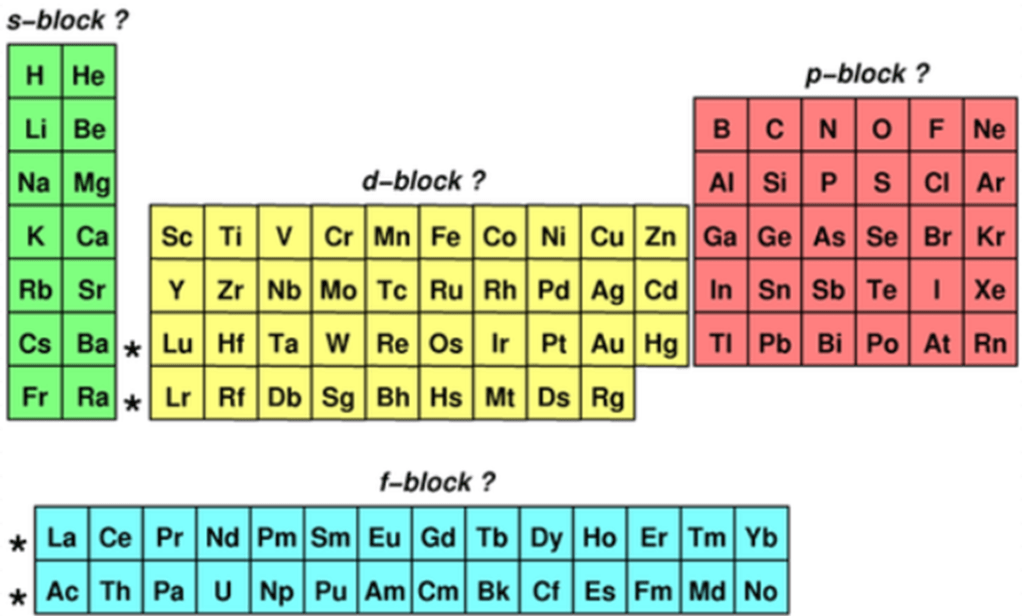
Hey there, curious minds! Have you ever wondered how scientists organize all the different elements in the world? Well, they have a special tool called the periodic table that helps them make sense of it all! Let’s dive into this colorful chart and uncover some of its secrets together.
1. Meet the Elements!
Each square on the periodic table is like a tiny treasure chest filled with information about an element. It has a name and a special symbol made up of one or two letters. These symbols are like secret codes that scientists use to talk about elements in a shorter way. For example, “O” stands for oxygen and “Hg” stands for mercury.
2. The Building Blocks
Above each element’s symbol, you’ll find its atomic number. This number tells you how many protons are in the nucleus of an atom of that element. It’s like a special ID number for each element! Below the symbol, you’ll see the element’s atomic mass, which is the average mass of all its different versions, or isotopes.
3. Family Reunion!
The periodic table is like a big family reunion where elements with similar traits hang out together. Columns on the table are called groups or families. Elements in the same group often behave similarly because they have the same number of valence electrons, which are the electrons in the outermost shell of an atom.
4. Taking a Row
Rows on the periodic table are called periods. Elements in the same period have the same number of electron shells. The period number helps you figure out how many shells an element has. It’s like stacking up building blocks!
5. Metal, Nonmetal, Metalloid
Elements can be classified as metals, nonmetals, or metalloids. Metals like to hang out on the left side of the periodic table, while nonmetals prefer the right side. Metalloids are like the bridge between metals and nonmetals. They’re a little bit of both!
6. Physical State and Colors
Some periodic tables show whether an element is a solid, liquid, or gas at room temperature. This can help you visualize the different states elements can be in. Also, some tables use colors to group elements with similar properties, making it easier to spot patterns and trends.
Do you want to know more about colors of elements in periodic table ? Click on the link below: 👇
https://alphaaura.in/2024/07/24/periodic-table/
Follow me on : 👇
Why It Matters
Understanding the periodic table is like having a superpower in the world of science. It helps scientists predict how elements will react with each other, create new materials, and unlock the mysteries of the universe. So, the next time you look at the periodic table, remember that each element has its own story to tell!
With this guide, you’re now equipped to explore the magical world of elements and unlock the secrets hidden within the periodic table. Happy exploring, young scientists!
Remember, the periodic table is your trusty map on the journey of discovery in the wonderful world of chemistry! 😊😊😊
Don’t forget to like and share and comment 🙏




 NurtureNest
Leave a comment